
Introduction
If you’ve spent even a minute in the world of digital marketing, social media or online business, then I am sure you have heard Meta’s name — dozens of times. Surprisingly, lots of people—experienced marketers even—have a very general and surface-level understanding of what Meta really is, how it works, what it owns, and most importantly all the reasons that make it so vital for businesses and advertisers everywhere.
No question is left unanswered in this complete guide. When you finish reading, you will fully understand what Meta is, how its ecosystem operates, why it has become the backbone of digital advertising for millions of businesses around the world and where tools like Meta Business Manager + verified business accounts fit in.
This guide has you covered whether you are a pure novice trying to learn the basics of what they need to promote your business, or have actually been integrating marketing with data and analytics for many years and simply wish to get a better grasp of what is happening on the platform that you work with every day.
What Is Meta? The Basic Definition
Meta Inc. Meta is an American multinational conglomerate holding company Mark Zuckerberg, the founder of Facebook A company that was founded initially as Facebook, Inc., the company changed its name to Meta Platforms, Inc. in October 2021.
The reasons for this rebranding are many. It echoed the aspirations of company to evolve beyond social media into what Zuckerberg calls the metaverse — a series of virtual and augmented present related experiences that he envisions will be the next version of the internet. More immediately, however, it completed the consolidation of the company identity built around its burgeoning catalogue of platforms and products under one modern brand.
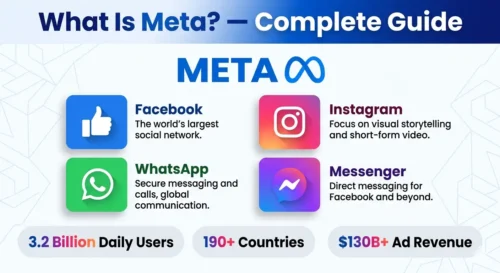
Meta is now one of the largest technology companies in the world, with a market capitalization that ranks among the top 10 tech firms globally. Regularly ranks amongst the top five most valuable companies in the world by market cap over $1 trillion. Each of its platforms reaches collectively more than 3.2 billion people every day — almost half the world population.
What Does Meta Own?
Meta is the parent company, and Meta platforms and products are the portfolio of companies. Well, Meta is not just one app — it is a connected family of apps that combine together to create arguably the biggest digital ecosystem ever built.
Facebook is Meta’s first and primary social media platform. Starting in 2004 as a college social network, it has inevitably turned into the biggest social network present on earth with over 3 billion monthly active users.
Facebook — it is where people connect with friends and family, join communities, follow businesses and public figures, consume news and entertainment, buy/sell items on Marketplace, watch videos. For businesses, Facebook represents an essential platform for organic content, community engagement, customer support and more importantly paid advertising.
Instagram was purchased by Meta for around $1 billion in 2012 — a deal that business experts say may go down as one of the greatest acquisitions! Over time, Instagram grew into far more than a simple photo-sharing app; it has developed itself into a fully formed social platform hosting 2 billion monthly active users.
Suitability of platform: Instagram is most powerful for visual brands, lifestyle businesses, influencer marketing and e-commerce. The elements that you can exploit — Stories, Reels, Shopping, and Live — have turned it in one of the most versatile platforms for both organic content and advertising.
For its part, Meta bought WhatsApp in 2014 for around 19 billion dollars. Many slammed the price back then. Fast forward to today, WhatsApp is used by more than 2 billion users in over 180 countries, and it has been classified as one of the most strategic acquisitions tech history.
WhatsApp is the most popular messaging app in most of the markets worldwide and top two across Asia, Latin America, Africa and Europe. WhatsApp Business API will be an increasingly important asset for customer communication and sales, as a driving relationship between Meta and D2C brands looking to make direct conversion using it as a marketing channel.
Messenger
Facebook MessengerInitially a component of Facebook’s built-in messaging tool, eventually spun out as a separate app. Messengers is a communications powerhouse in its own right (It has more than 1 billion monthly active users) — and an important advertising destination for businesses running Click-to-Messenger ad campaigns.
Threads
Threads (2023) — based on your Twitter/X feed, this text conversational platform launched in 2023 as Meta’s rival to that network and worked through Instagram. Threads, despite having hundreds of millions of users, is in its earliest stages of growth and represents the latest expansion of Meta’s social media empire.
Meta Quest (Virtual Reality)
For its part, Meta has been putting a lot of resources into the VR space with its most recent additions being in the Meta Quest line of VR headsets. This is the basis of Meta’s vision for success in the metaverse — virtual worlds for work, gaming, social networking and commerce. Although Meta Quest is still a bit early on in the commercialisation cycle, it shows way ahead for the company’s long-term strategy.
Meta AI
Meta — an artificial intelligence assistant across all Meta’s platforms was launched in 2024 and 2025. Using Meta AI, you can ask questions, create images, receive recommendations and engage with AI on Facebook, Instagram, WhatsApp and Messenger directly. This also powers Meta’s ad optimization systems, creative tools and audience targeting algorithms.
Why Facebook Rebranded To Meta
Amid the above strategic considerations, Facebook, Inc. had rebranded to Meta Platforms, Inc. in October 2021:
The Metaverse Vision
Mark Zuckerberg has unveiled the rebrand alongside an expansive vision for the metaverse — a term used to describe a sort of next-generation internet based on immersive, interconnected virtual and augmented reality experiences. Meta name (translated from Greek: “beyond”) indicated the company’s desire to go beyond social networks and create the next step in the development of human digital communication.
Brand Separation
When the rebranding finally happened, “Facebook” had taken on new meaning in big ways — privacy scandals, political advertising debate, misinformation fears and mounting antitrust scrutiny. The rebranding of Meta enabled the company to have a clean corporate identity while maintaining separate platform brands (Facebook, Instagram, WhatsApp).
Portfolio Unification
With the company having grown to own dozens of massive platforms, simply naming it Facebook no longer represented the entirety of what was under its ownership umbrella. Meta offered an umbrella brand that was contextual enough to allow all platforms to exist on their own without obscuring the flagship social network.
How Meta Works: The Advertising Machine
If you want to use Meta’s platforms for business (and really do you even want to not know this stuff?
At its core, Meta is a advertising company. Despite all the products it has in its business portfolio, and the money spent on pushing into the metaverse, Meta relies overwhelmingly on advertising as a revenue source — over 95% of total revenues.
Meta: In 2024, it generated over $130 billion in advertising revenue, the second-largest digital ad platform in the world after Google. This amazing(ly high) revenue number can be boiled down to one simple but profound dynamic: Meta has billions of people who use its platforms, and businesses are willing to pay money for ads targeted at these populations.
How Meta’s Advertising Works
Meta uses an auction system for its ads platform. Advertisers compete with each other for the opportunity to display ads to targeted audiences. Your advertising cost is determined by:
- The number of other advertisers targeting the same demographic
- How relevant your ad is to the folks you are targeting
- Your ad’s likelihood of conversion based on the campaign objective you selected
- The overall quality and engagement history of your ad account
Meta’s artificial intelligence systems evaluate all of these elements in real-time — conducting millions, if not billions, of auctions every second — deciding who sees which ad on what platform and at what price.
This system is extraordinarily sophisticated. Meta has learned a huge amount about their users any and everything from interests, behaviour, age range, purchasing inclinations to online traffics,and tries to match advertisers with the closest possible prospects.
Core components of Meta’s Advertising Ecosystem
Meta, thanks to its powerful advertising ecosystem with various components acting in synergy, is the organic choice for businesses and marketers of different fields.
Meta Ads Manager
If you want to create and manage ads across Facebook, Instagram, Messenger, and the Audience Network then this might just be your best friend.Meta Ads Manager has been the very core interface for all advertisers. Advertisers use Ads Manager to determine what their campaign goals are, where the target audience lies, the budget for campaigns, uploading creative assets and tracking performance.
Meta Business Manager
The Meta Business Manager (also known as the Meta Business Suite or Facebook Business Manager) is a centralized management platform for managing businesses on the various platforms within Meta. This is essentially going to be your office where you can manage all of your businesses Facebook Pages, ad accounts, Instagram Profiles, pixels, team members and any other business assets right in one spot.
Business Manager forms the backbone of serious Meta advertising. In the absence of it, cross-platform business asset management on Meta is an uncoordinated and insecure process that does not scale at all.
Meta Business Suite
Meta Business Suite — the content management side of Meta’s business tools, used by businesses to schedule posts or manage their inbox across Facebook and Instagram, view page insights, and perform day-to-day social media management.
Facebook Pixel and Conversions API
Facebook Pixel — a tracking code snippet placed on a company’s website, which records and transmits visitors behavior data back to Meta. This data is utilized for audience targeting, conversion optimization, and measuring the effectiveness of a given campaign.
The Conversions API is more sophisticated server-side tracking for conversion events that collects data directly from the business’s server rather than through cookies in a web browser — allowing for more accurate and complete data collection, in a more privacy-compliant way.
Meta Commerce Manager
Commerce Manager is Meta’s e-ccommerce business hub — product catalogs are managed, Facebook Shops created and access Marketplace listings. Major e-commerce platforms such as Shopify and WooCommerce can be integrated with it to sync products effortlessly.
Why Is Meta Business Verification Important
Business verification is one of the most vital — and also least understood — parts of Meta’s business ecosystem.
Meta business verification businesses go through a submission process providing official documents for confirming their legal identity according to the laws in place. A verification status is highly pragmatic and it denotes a business’s Meta presence once it has been verified.
What Verification Unlocks
Increased spending limits on ads — New ad accounts are assigned very low daily limits. MyAccountVerified Business Managers have drastically higher limits, ranging from $1,000 to $5,000 all the way to unlimited daily spend based on account history.
Advanced advertising features — MAny of the advanced advertisement capabilities from Meta, like certain Advantage+ functionalities and full WhatsApp API access (only), are limited to verified businesses.
Verified badge on ads — In 2026, Meta shows a verified business icon in the ads shown by accounts with a verified account — an indicator of trust that significantly increases the effectiveness of advertising.
More account stability — Verified accounts face less rigid algorithmic moderation from Meta, and provide expedited access to human review in the event of issues.
Access the WhatsApp API — To run Click-to-WhatsApp advertising campaigns, a verified Business Manager connected to a verified WhatsApp Business Account is required.
The Verification Challenge
Meta requires you to prove your business is legitimate with official documents — registration certificates, tax documents, utility bills — to match the business information in your Business Manager. This can take days, along with repetition if the documentation is rejected.
This is why a lot of serious advertisers and media buyers tend to buy pre-verified Business Manager accounts from trusted sellers — avoiding the whole verification process and getting instant access to all the benefits that verification brings.
Meta’s Impact on Global Business
Meta’s reach through global commerce and business communication can’t be over-stated.
Small business lifeline — For hundreds of millions of small businesses, Meta’s local Facebook and Instagram pages are their main marketing channel. It also provided, for the first time ever, ways to hit precisely defined local and global audiences on fairly tight advertising budgets — kind of democratizing marketing like never before.
The e-commerce acceleration – Meta’s commerce tools = Facebook Shops, Instagram Shopping, WhatsApp catalogs and in-app checkout (new direct-to-consumer channels with less friction to provide businesses with new ways of selling through social media that will allow them to make a purchase).
Worldwide correspondence — WhatsApp has turned into the most utilized business device for a huge number of organizations, particularly in developing markets. The addition of the WhatsApp Business API to Meta’s advertising ecosystem has opened up new and powerful capabilities for acquiring and retaining customers.
Meta’s platforms fuel a large-scale ecosystem of content creators, influencers and publishers who are able to build businesses on top of Meta’s audience and monetization capabilities.
What’s Next For Meta: The Net Benefit
Their trajectory at Meta suggests a number of game-changing developments that will dictate the shape of its platforms and their effect on business in years to come:
Deeper AI integration — Meta is integrating its AI technology throughout the platform experience, including everything from content recommendations to advertising optimization to customer service automation.
Metaverse commerce— The expandable wing of [O8] as the advent of Meta Quest will usher in new avenues in immersive environments for virtual commerce, advertising and brand experiences.
WhatsApp— Meta seems to be very serious with their investment into making WhatsApp a commerce platform complete with payment integration, product catalogs and business automation all embedded right in the messaging experience.
Enhanced creator monetization — New tools will empower creators to monetize directly on Meta platforms, expanding the creator economy and generating new advertising inventory.
Conclusion
Meta has More Going on Than Just a Social Media Company Its the biggest digital advertising ecosystem in the world — a nexus of interconnected platforms that reaches more than half the worlds internet population every day.
For marketers, knowing Meta is knowing the most powerful modern marketing infrastructure in existence. Whether navigating Facebook’s wide-ranging reach, harnessing Instagram for visual commerce, leveraging WhatsApp and its conversational selling capabilities or focusing growth in the precision targeting power of Meta Ads Manager — the business growth potential delivered through Metas ecosystem is phenomenal.
And at the heart of unlocking Meta’s most potent business arsenal is one vital asset: a verified Meta Business Manager account. This ties very closely to verification, which lets you jump further in the lines for higher spend limits, advanced features and greater stability, plus the trust signals that help improve Meta ad performance.
No matter if you’ve just begun targeting Meta as a business or are a pro on the platform with how to amplify your performance, knowing what is meta—and how you use its ecosystem for strategic advantage— are two foundational pieces of building success through digital marketing in 2026.
Tags:
#WhatIsMeta #MetaPlatform #MetaExplained #FacebookMeta #MetaBusiness #MetaAdvertising #MetaBusinessManager #VerifiedBM #MetaAds #FacebookInstagramWhatsApp #MetaEcosystem #DigitalMarketing #MetaForBusiness #SocialMediaMarketing #MetaBM #WhatIsMeta